Foreword on the collaboration with John Goldsmith: The images on this page are the results of the collaboration between John Goldsmith and myself. You can find on John’s website https://www.celestialvisions.com.au/ more images of the eclipse that he captured, as well as more detailed description of the challenges and the experience of the eclipse itself.
John, who lives in Australia, approached me before the eclipse for collaborating on imaging the 2023 Total Solar Eclipse. As I was not making it to Australia for this eclipse, the idea of this collaboration enchanted me. Being able to produce high quality images of this eclipse, that was promised to be very spectacular, was kind of a relief from the fact that I was going to miss it myself. The imaging project quickly expanded to an ambitious multi-focal lengths and multi-cameras project, including long focal length for high resolution and shorter ones for larger field of view.
John made an incredible work of gathering camera bodies and lenses suitable for getting the highest level of quality of the final images, as well as preparation and tackling the many challenges of this eclipse located in a remote location, up to the eclipse itself where he managed perfectly 5 camera setups, including backups, to fulfill the targets of the collaboration. This is truly a feat, especially considering that this was John’s first total solar eclipse. Like my results from the 2017 total solar eclipse which was also my first one (ignoring the overcast 1999 eclipse), the images of this eclipse prove that, to achieve great results on imaging a total solar eclipse, what is needed is not experience from many total eclipses, but high level of motivation and dedication for going through serious preparation, anticipation of issues, rehearsals, as well as quick reactions for tackling with last minutes issues in conditions where you are mostly by yourself in the middle of nowhere.
We want to greatly thank all the collaborators, supporters and teamwork who helped in making these images possible:
- James Athanasou, Western Australian astrophotographer, for logistics support, teamwork and supply of one Canon 6DMkII camera body.
- Dr Chris Thorne, for supply of a Canon 300mm f2.8 lens, and for booking our accommodation more than three years ago!
- To all of the staff at Midland Camera House, (Midland, Western Australia), including owner Russell Payne, and in particular, Thanh Vu, for technical support and supply of Canon 6DMkII cameras and related accessories.
High resolution image with 900mm focal length, 130mm diameter apochromatic refractor

This composite image (high resolution here) shows the majestic solar corona during the 2023 total solar eclipse, with many prominences, streamers, loops, and even a coronal mass ejection visible in the bottom left part of the image. The image is a composite of 46 images acquired with different exposure time during the 1 minute totality of the eclipse.
To me, this image is probably one of the most beautiful image of an eclipse with “solar maximum” type corona, with a lot of activity in the corona, many prominences, a lot of activity in the corona, loops, streamers and a coronal mass ejection visible in the bottom left part of the image.
46 images with exposure time ranging from 1/2000s to 2s were acquired during the short totality of about 1 minute, with a 900mm f/7 apochromatic refractor and Canon 6D MarkII. Those images have been combined together to create this enhanced image of the eclipse, showing at the same time the bright prominences, the details of the corona.
the 3 main steps of image processing for obtaining such an image are:
- registration of the images on the details of the corona
- fusion of all the images, in a linear, high dynamic range, and low noise image.
- enhancement of the details of the details of the corona, to reveal all the details captured, while preserving a natural look of the image
Large Field of View image with 85mm f/1.4 lens
The large Field of View image reveals the solar corona extending into space, with radiating streamers, among a sky full of stars. The coronal mass ejection that was happening during totality, is visible on the bottom left of the sun, while planet Jupiter hovers on the right hand side of the sun.
Although the sun was totally hidden by the moon, the dusk-like sky background during the eclipse remained much too bright for all these details to be visible to eye. Yet, those details were captured by the camera, and revealed with the aid of digital background subtraction.
96 images with 0.33s exposure at 100 ISO and lens wide opened at f/1.4 were acquired during totality with this setup.
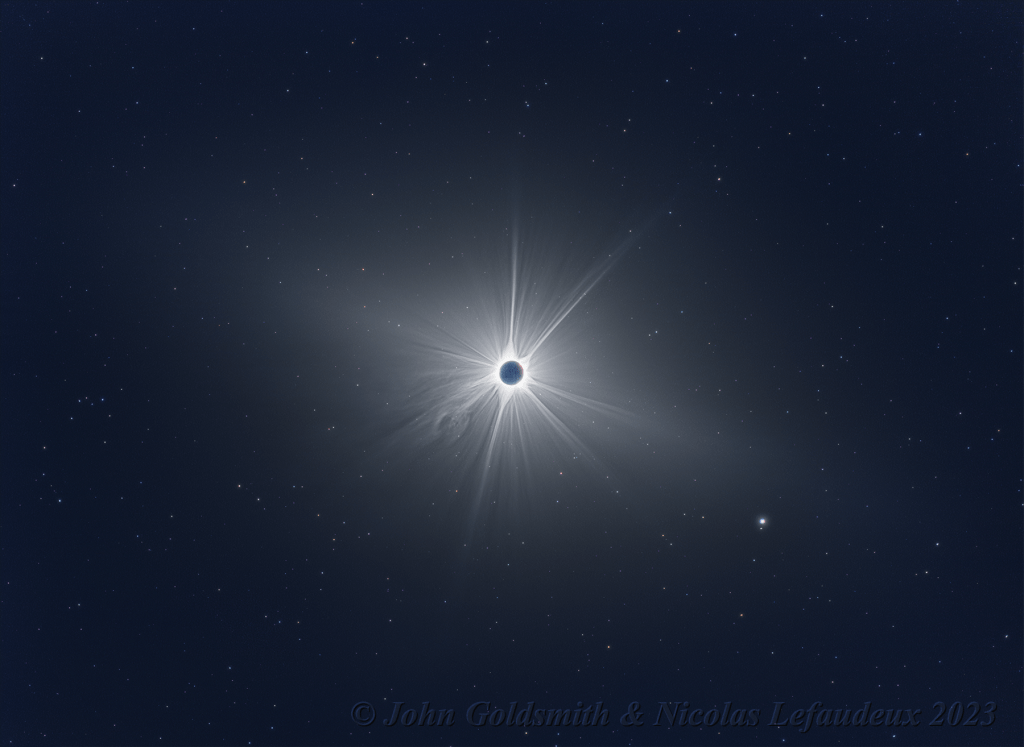
This large field of view image shows the solar corona extending into space among hundreds of background stars (high resolution here).

Visual appearance of the 2023 Eclipse. In order to render the visual appearance of the eclipse, download the image here, open it in full screen on your computer, adjust your monitor brightness at max value and place yourself in a dark environment, at the right distance from the screen. In those condition, the results should be really close to what could be seen visually. For more information on how this image was created, you can have a look at my 2017 solar eclipse page on visual appearance.
 HDR astrophotography by Nicolas Lefaudeux