This eclipse was really an adventure. It brought us all the way up to Illinois in search of clear skies. Despite some thin cirrus during the first half of the totality, the images are excellent, and the amount of data collected is just huge, so it will take a lot of time to process all of it. Thanks to everyone who made this possible, Gordon Falconer for getting us out of big rental car trouble, as well as João Lucreddi and Jean-Marc Lecleire and his teams who were ready to help too, Robert Yen for location finding and providing last minute spare power supply for telescope, Nikon France for lending great cameras bodies and lenses, and Nabila Meknoun for the help and handling of these adventures !
Processing eclipse images is a real ordeal. although you might think that with my previous experience, things would got easier, that is definitely not the case with this eclipse.
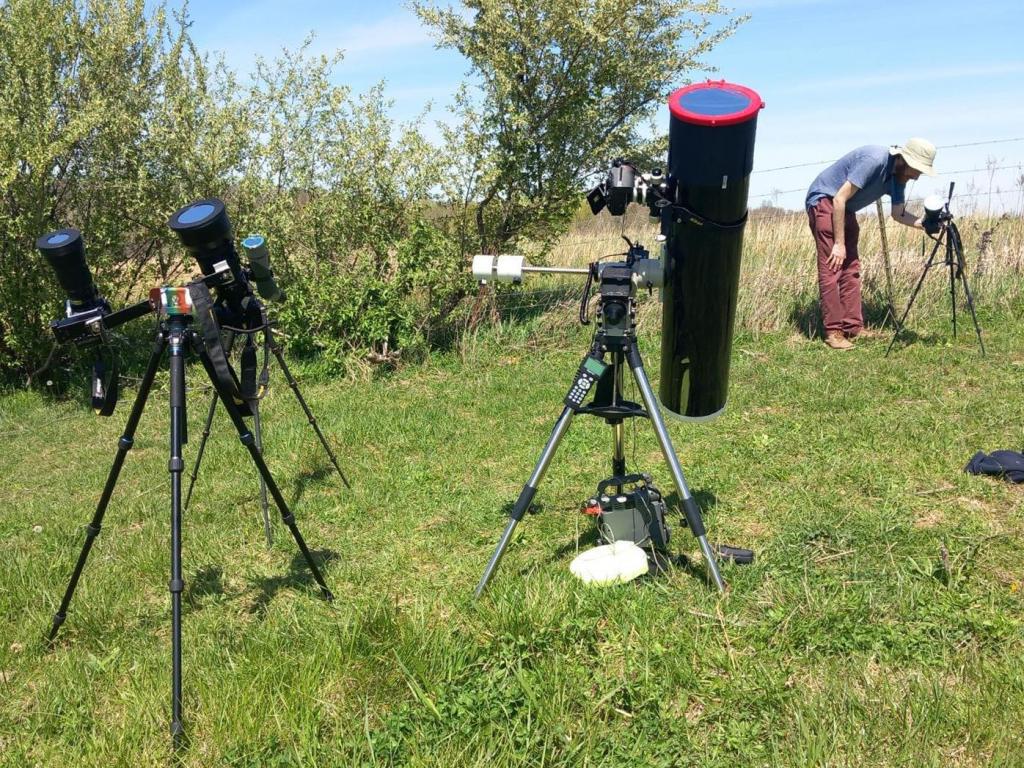
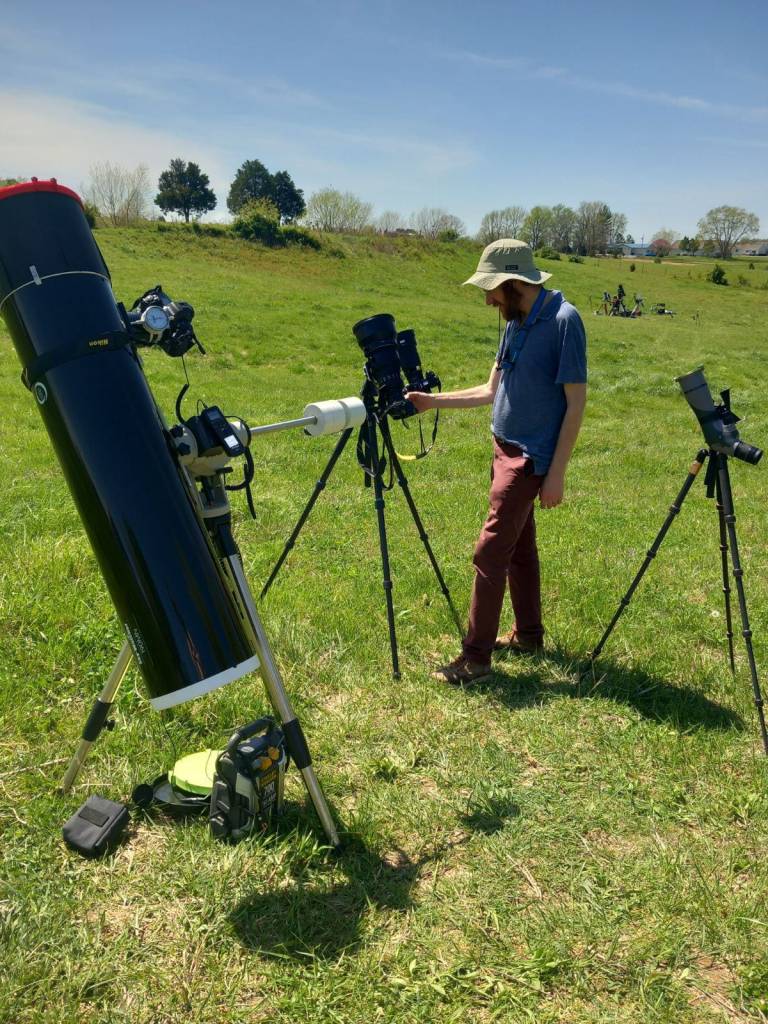
HR resolution setup : 190mm diameter Maksutov Newton Telescope and Nikon Z8
HIGH RESOLUTION HDR IMAGE OF THE SOLAR CORONA
With its high resolution, very low noise, and relatively large field of view, this HDR composite image reveals an unprecedented amount of coronal structures carved by the complex magnetic field of the sun during April 2024 total solar eclipse: pink prominences, intricate plasma loops, streamers, narrow plumes, dark blobs and a variety of low contrast features are captured virtually everywhere in the image.
The larger amount of details is revealed thanks to a much better signal-to-noise ratio compared to my previous eclipse images (and i think to any previous eclipse image). This is obtained by the combined effect of the 4-minutes duration of totality, 190mm diameter telescope , and fast Nikon Z8 camera body. This allowed a gigantic volume of data to be acquired during April’s eclipse compared to previous eclipses. During the totality, I acquired more than 1000 images at 46megapixels, including 88 sets of 9 exposure brackets during the middle of the totality. Altogether, this is more than 46 billions of pixels ! To put this in perspective, this is more than 10 times more data than my previous solar eclipses!
With this huge amount of data, most of the steps of my previous processing algorithms were too slow and unable to cope with the larger memory requirements. Thus, I had to simplify and rewrite most of my steps of processing to handle the data more efficiently.
All this work paid off and allowed to create this extraordinary HDR composite showing the solar corona with both high resolution and large field of view.

HDR composite showing the intricate structure of the solar corona during the total solar eclipse of April 2024 (higher resolution here)

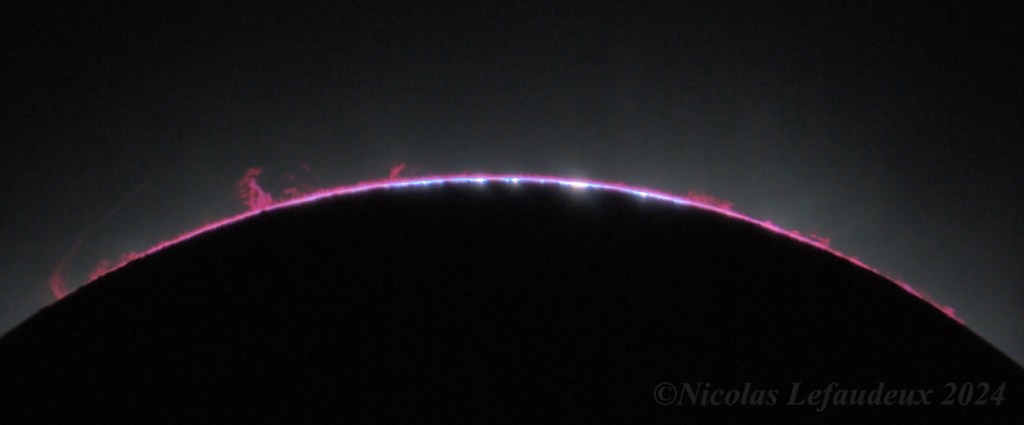
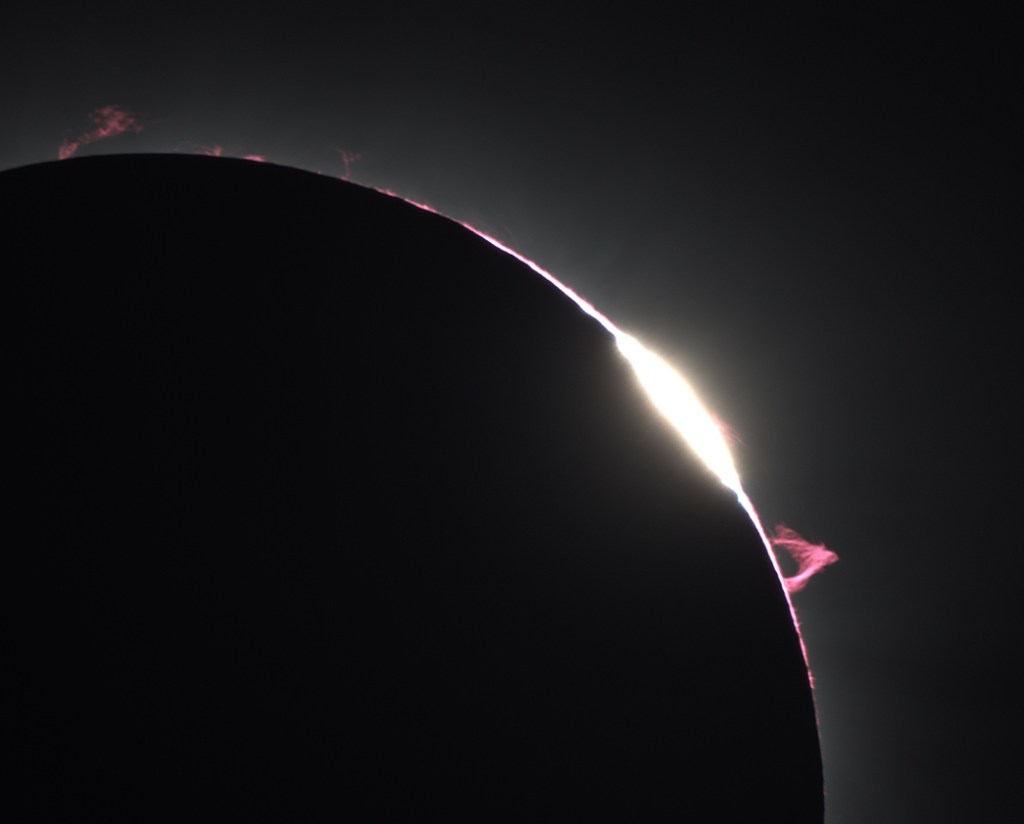
Combined images of the solar prominences captured at second and third contacts (higher resolution here)
technical details:
- Camera: Nikon Z8, set at 64iso. 88 sets of 9 exposures bracketting (1s to 1/1600s exposure) during the middle of the totality, shorter exposures at second and third contacts.
- Telescope: Skywatcher Maksutov-Newton telescope, 190mm diameter, with custom corrector (resulting focal length 930mm)
200mm focal length setup: Nikkor 200mm f/2 and Nikon Z6ii
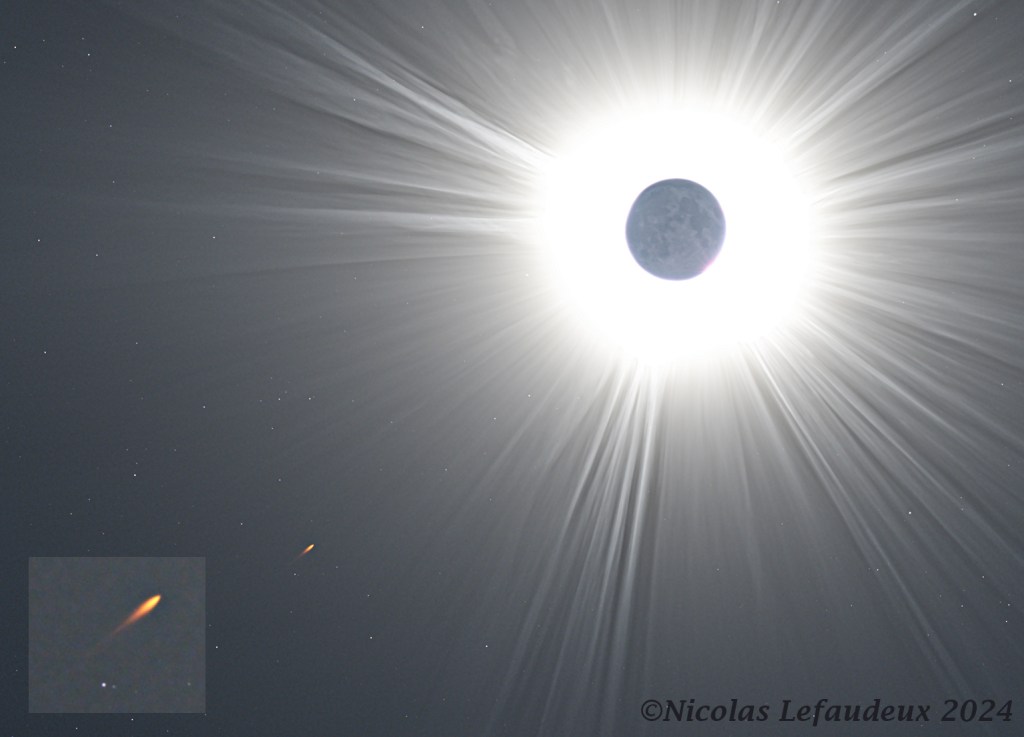
The image showcases the solar corona filling the entire frame, set against hundreds of background stars. The corona displays the usual radiating streamers and also unusual structures like blobs. Notably, the red sungrazer comet SOHO 5008 is seen plunging into the corona, facing its deadly fate of disintegration.
The long duration of the eclipse, captured with a fast Nikkor 200mm f/2 lens and a Nikon Z6ii camera body, allowed for an incredible amount of photons to be gathered, achieving an extremely high signal-to-noise ratio. A total of 531 images with exposures of 1/2s, 1/4s, and 1/8s were taken on an untracked tripod, cumulating 155s of exposure. With these, structures of the solar corona with very low contrast are revealed, as well as stars down to magnitude 12.5.
The saturated inner corona was managed by filling the HDR image with data from the high-resolution setup.

Family portrait of our Solar System: 4-frame-panorama with Nikkor Z 50mm f/1.2 and Nikon Z6ii
All the planets of our solar system surround our Sun eclipsed by the Moon, accompanied by periodic comet Pons-Brooks, sungrazer comet SOHO 5008, the Pleiades, and earthly cirrus clouds. While the main planets are easily recognized, remote Uranus and Nepture are lost among the hundreds of background stars.

Tests done before the eclipse showed Neptune would not be captured using a short focal length lens. Capturing it required using longer focal length. Thus this image is a panorama made of 4 tiles using Nikkor Z 50mm f1.2 on Nikon Z6II. The panorama was automated using Nodal Ninja motorized rotation head. Altogether, more than 500 images with 1/8s, 1/4s, 1/2s exposure, at 100ISO and full aperture have been acquired with this setup. the saturated inner solar corona was recorded with the longer focal length setups. On this image, the solar corona is captured up to about 30 solar radii, and the stars down to limiting magnitude 9.5.
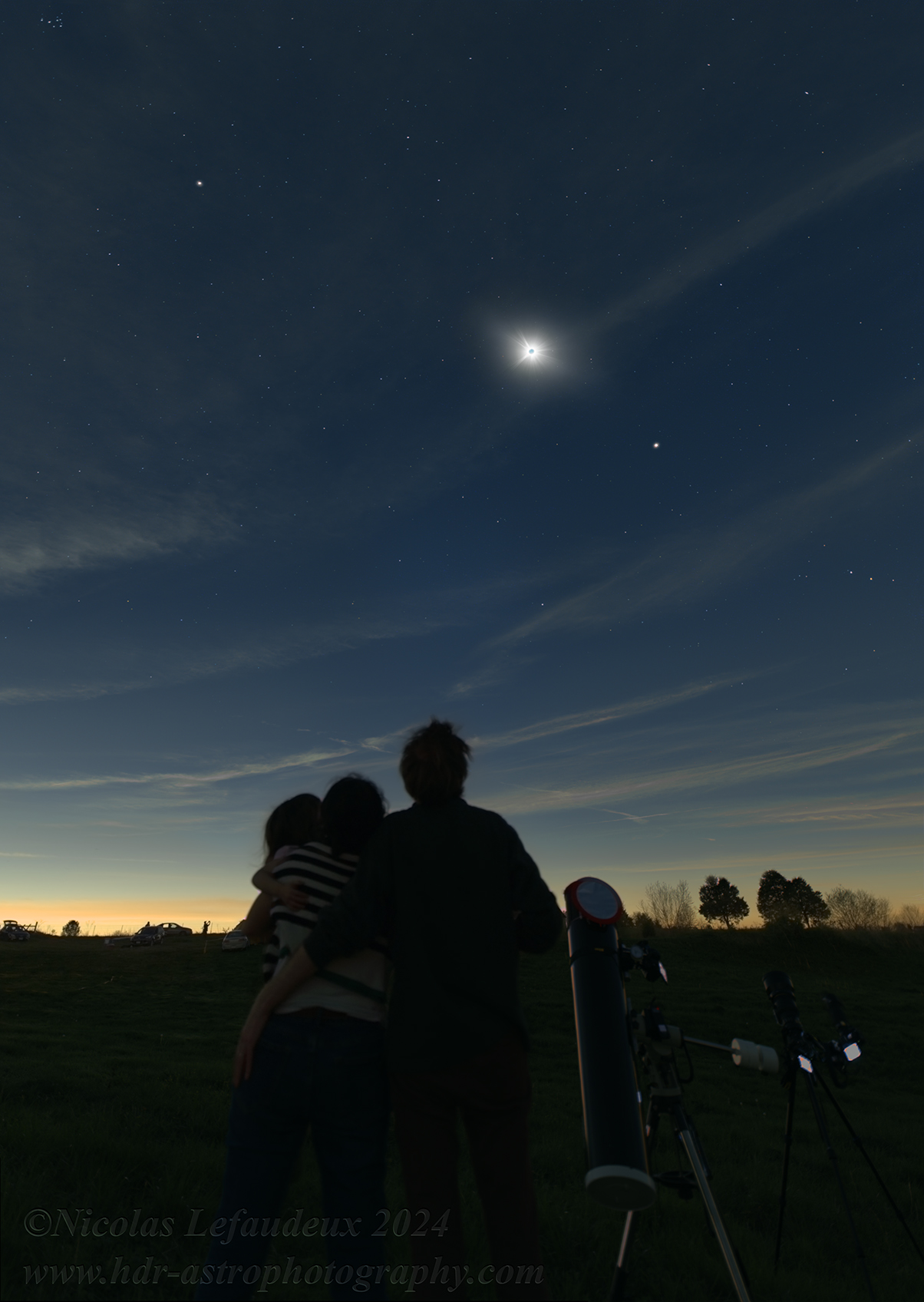
Watching the eclipse: Nikon Z6 and Sigma 14mm f/1.8
This is my final image of the 2024 eclipse. I wanted to make a nice memory image, with the eclipse in the sky, the surrounding landscape during totality with sunset colors, and my family and me in the foreground as we watch the eclipse unfold. The extended corona of the eclipsed Sun is visible, together with the solar system planets, and many stars revealed by the combinations of almost 500 frames with exposure 1/20s, 1/4s, and 1s at ISO 100 captured during totality with a Nikon Z6 and Sigma 14 mm f/1.8 lens used at full aperture.
THE ELUSIVE MESOSPHERE OF OUR SUN:
Have you heard of the solar mesosphere before ? the mesophere is a very thin layer of the sun atmosphere, located between the solar surface (photosphere) and the pink chromosphere. It is usually captured through flash spectrum where it shows up as a myriad of blue emission lines.
it is probably the first time the mesosphere is captured so clearly in regular imaging. Capturing the mesosphere requires both excellent resolution, and ultrashort exposure. I have captured it at the beginning of the totality, where it shows up as a very bright, blue layer at the bottom of the chromosphere. Even with 1/32000s of exposure and 64ISO, the mesophere was almost saturating the sensor.
Captured with Nikon Z8, 1/32000s, 64ISO, and 190mm diameter Maksutov Newton telescope.

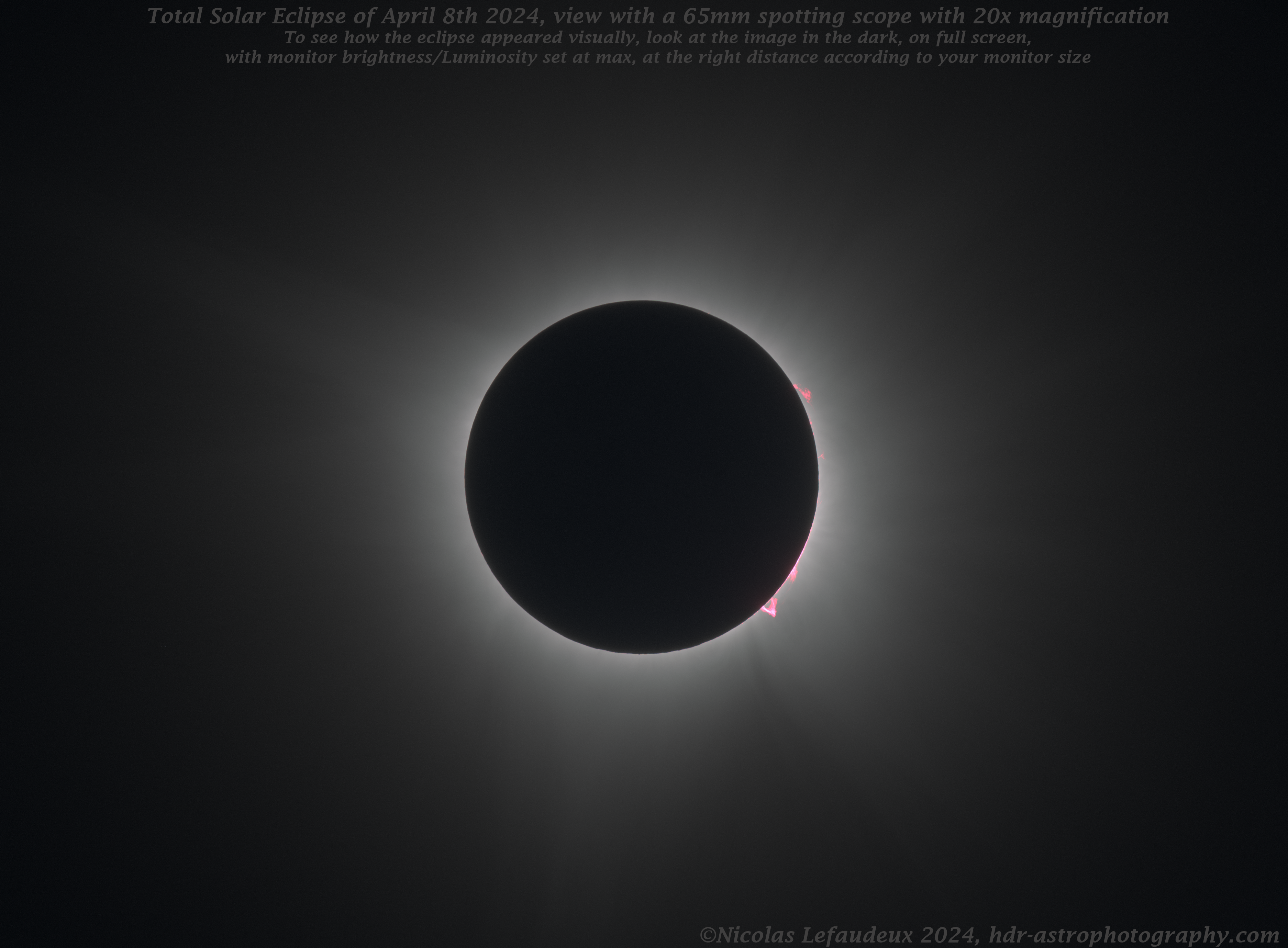
NAKED EYE APPEARANCE OF THE ECLIPSE
simulation of the naked eye appearance of the eclipse through a 65mm diameter spotting scope at 20x magnification. the prominence was a real eye catcher that was hard not to look at. processed similarly as what is described here.
Simulation of the naked eye appearance of the eclipse through Pentax 4×20 binoculars. I bought these just before the eclipse as i estimated that this would be somehow the ideal magnification for a global view of the streamers. indeed, these low magnification and large exit pupil binoculars gave one of the best views of eclipse i have ever had. the large field of view gave a full image of the eclipse, but with much more brilliance and much more details than the naked eye. it is very unique sight compared to usual binoculars or spotting scope. if you are interested in getting nice view of eclipse, i definitely advise getting such binoculars.

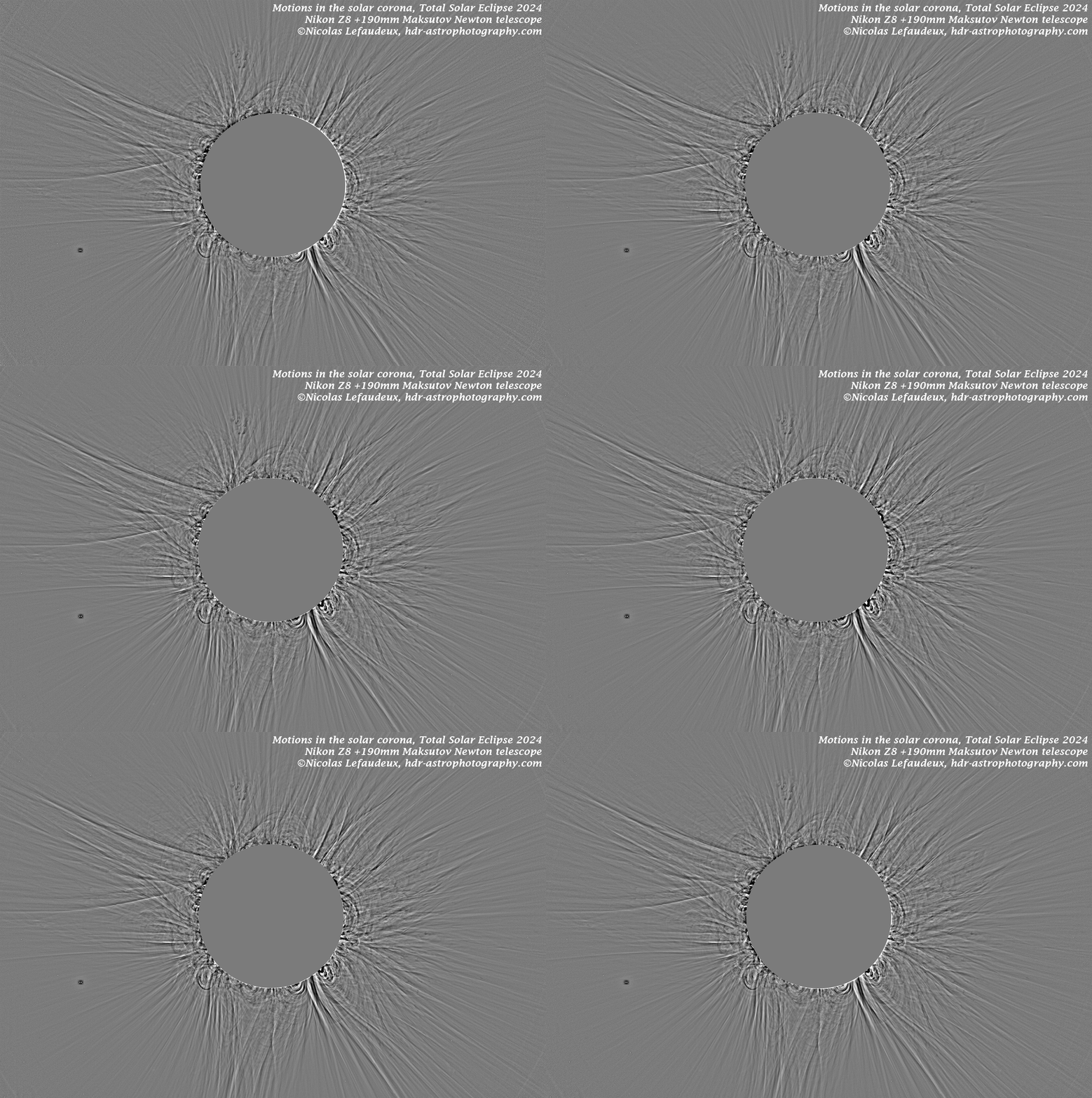
MOTIONS IN THE SOLAR CORONA, UPDATE WITH A BIG SURPRISE
With the long duration of the eclipse, i was expecting that it would be possible to capture a lot of moving features in the corona. and indeed, there was a lot of things going on in the corona, including changing coronal streamers and jets, the wake of a CME, a group of quite unusual dark blobs falling toward the sun, and a moving loop in the inner corona.
But there is a truly astonishing feature hidden in the data. For the first time, coronal waves have been captured !
To reveal them, I processed with a running difference of frames separated with about 45s. this removes the static features and reveals the nature of the low contrast structures seen in regular animations. Coronal waves are everywhere, radiating from the sun, but they are not evenly emitted. For instance, there seems to be an important source of waves in the upper part of the image.
i have tried to estimate some figures, i found:
- time period ~200s (frequency ~5mHz)
- spatial period ~55000km
- phase velocity ~250km/s
from discussion with solar physicist: velocity of the different types of waves is similar in the solar corona, so it is not possible to use this parameter to tell the nature of the waves. Alfvén waves are transverse waves, while the waves detected seem to be longitudinal waves.
If you know some solar physicists that could help analyze the data, and identify the nature of these waves, you can share with them.



SUNGRAZER COMET SOHO-5008
Some preliminary processed images showing the sungrazer comet SOHO-5008 captured during the eclipse. The color of the comet is extraordinary, there is no saturation enhancement ! it shows strong in the red channel, a bit less strong in the green channel, and almost invisible in the blue channel. Probably a very strong sodium emission as the comet was disintegrating at the time of the eclipse.
Image acquired with a Nikkor 200mm f2 used at full aperture, and Nikon Z6ii, gathering a total of 531 images during totality, 155s of cumulated exposure ! The final image will use the telescope data to fill the inner corona saturated on the 200mm image.


general overview

 HDR astrophotography by Nicolas Lefaudeux