Prospects for future comet C/2025 A6 Lemmon
A very photogenic comet with long gas tail, detectable with binoculars under dark skies?
UPDATE (10th of October 2025)
During the period of September 25th to October 5th, comet C/2025 A6 Lemmon has developped a gas tail and a short dust tail. The length of the gas tail reported by observers has been in the lower range of the length expected in the initial simulations. Also, its brightness increase has somehow been slower than expected, resulting in a maximum magnitude now expected around 3.5 instead of 2.8. Altogether, the shorter tail and lower brightness have significantly reduced the expected display of comet Lemmon.
SUMMARY
Comet Lemmon is a gaseous comet that will approach Earth to a minimum distance of 0.6 AU, approximately two weeks before its perihelion on November 8. It will be visible only from the Northern Hemisphere. The highlight of the apparition will occur between October 17 and 27, when the comet will be at a relatively large solar elongation (from 45° down to 35°) and free from moonlight interference.
With a predicted maximum magnitude of around 3.5, the comet should not become a significant naked-eye object. However, thanks to its relatively large solar elongation and the absence of moon interference, very spectacular images of its ion tail can be expected. Given the inherent uncertainty in predicting the appearance of ion tails, comet Lemmon’s tail could reach a maximum length between 15° to 30° in deep exposure images. Some of the tail should be visible with binoculars. The first degrees of tail might become marginally visible to the unaided eye from dark-sky sites.
Comet C/2025 A6 Lemmon should not reach the extreme tail length of some previous gaseous comets such as C/2002 T7 (LINEAR) and C/2021 A1 (Leonard).
If any large outburst happens during the time of best visibility, the comet has the potential to become a more significant naked eye comet. However, as it will be around two weeks before perihelion, large outbursts don’t seem very likely.
Note: Comet C/2025 A6 Lemmon is a very gaseous comet. The appearance of ionic tails in gaseous comets is more difficult to predict than that of dust tails, for several reasons. Among the various gaseous species emitted by such comets, two are particularly important for their visual appearance: neutral diatomic carbon (C₂), which creates the characteristic green coma, and carbon monoxide ions (CO⁺), which are responsible for the blue ionic tail. Gaseous comets can emit varying proportions of these species. Some produce much more C₂ than CO⁺, resulting in a prominent green coma but little or no visible ion tail. Examples include comets C/1983 H1 IRAS-Araki-Alcock, 46P Wirtanen or 252P/LINEAR, all of which displayed a coma without any significant gas tail. Conversely, other gaseous comets may exhibit a well-defined tail with little to no visible coma. Notable examples include comets C/1908 R1 Morehouse, C/1961 R1 Humason and more recently C/2016 R2 PANSTARRS.
Beyond composition, several other factors influence the appearance of a comet’s tail. Unlike dust tails—which consist of particles emitted over several days or weeks and represent the comet’s average long-term activity—the ion tail is formed from gas released over just a few hours. As a result, it is highly sensitive to short-term variations in the comet’s activity. Furthermore, the appearance of the gas tail is strongly influenced by solar wind conditions. Lastly, the habit of comet to defy predictions, with outbursts or unexpected fading could dramatically affect the appearance of the comet and its tail.
Thus the appearance and length of the tail of a gaseous comet is pretty uncertain, and expected to vary significantly on a daily basis. So the simulations below should just be considered as one plausible scenario for the future apparition of comet C/2025 A6 Lemmon. As of October 10th, the tail length of comet Lemmon seems shorter than what could be expected from an average gaseous comet.
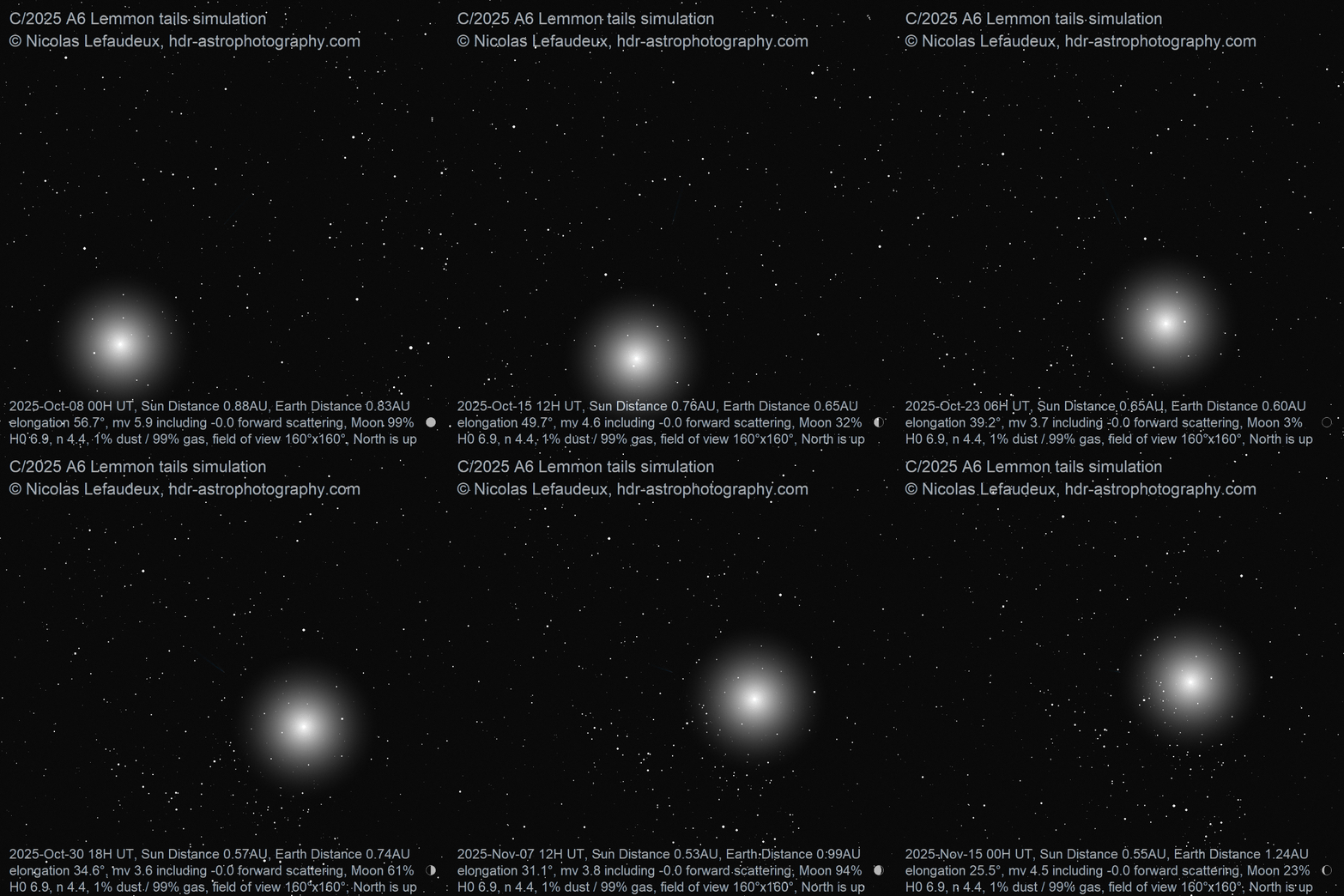
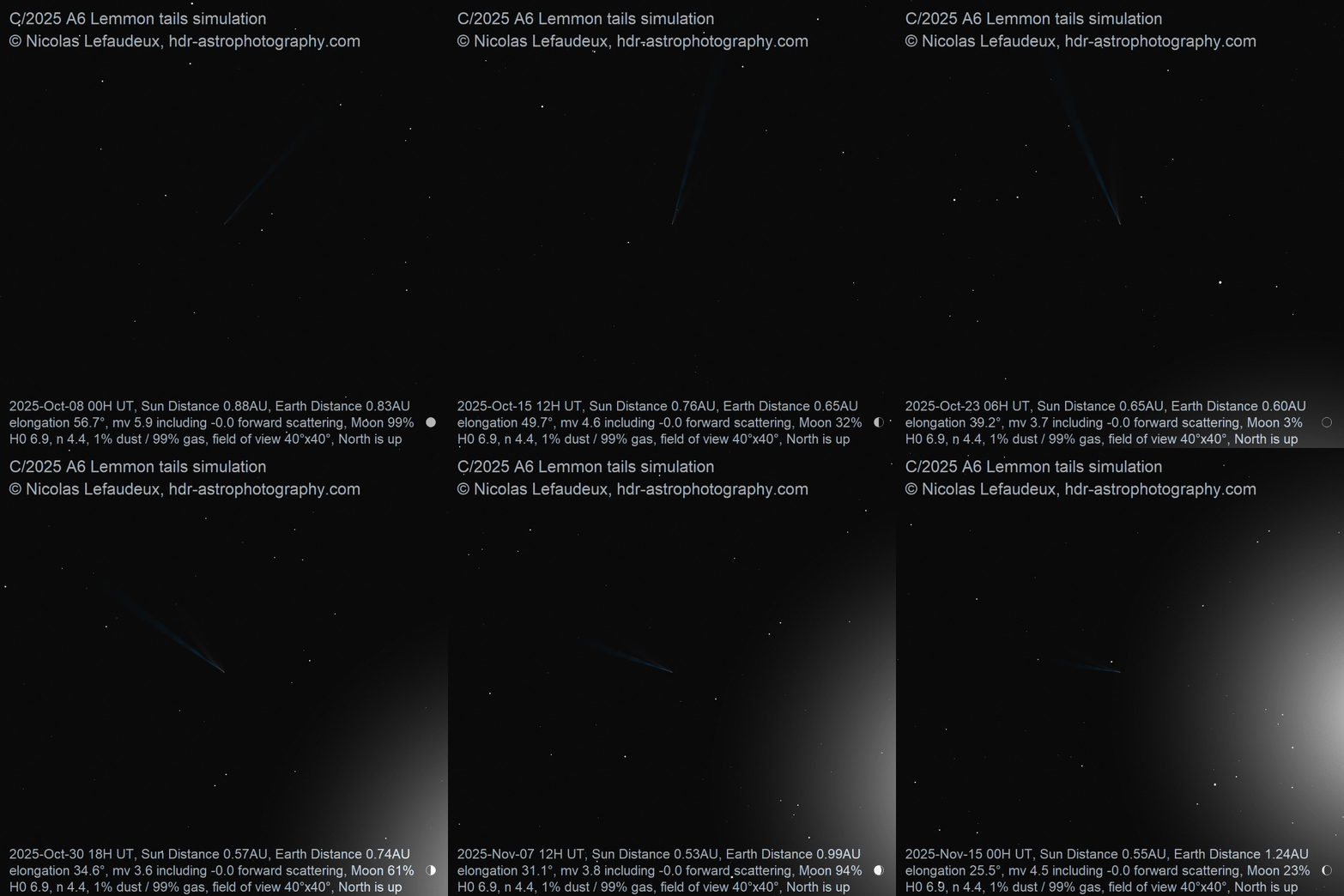
DETAILED ANALYSIS
The simulation assumes that comet Lemmon will reach a maximum magnitude around 3.5 at the end of October.
Between September 25th and October 5th, the comet was be visible in the morning sky, with no interference from moonlight. The comet displayed a nice and active plasma tail on images. During this period, the gas tail increased both in brightness and length, from a few degrees to more than 10° on deep, large field of view images.
Around October 15th, the comet transitions to the evening sky and it will be possible again to see the comet without moonlight interference. Then the highlight of the apparition of the comet will begin. During the period between 16th and 27th of October, the magnitude of the comet should increase from magnitude 5 to brighter than magnitude 4, and the tail will be at its longest, probably measuring between 10° and 20° photographically. With a solar elongation around 40°, the conditions will be ideal for very spectacular images of the complex plasma tail of the comet during this period. According to the simulation, the maximum tail length should be around October 20th, with a maximum tail length between 15° and 30° photographically.
The tail should stay long and keep increasing in terms of surface brightness until the moon interferes, on October 27th. The surface brightness of the tail could be enough for some part of it to be seen visually from dark skies with binoculars, and possibly to the unaided eye, especially in the late part of the period when the tail’s surface brightness should be the highest. Around this time, the dust tail could reach length possibly as much as 5°.
When the moon does not interfere again on November 7th, the gas tail should still be more than 5° long, and possibly still spectacular photographically as the comet will be at perihelion then. The tails of the comet will then shorten rapidly together as the comet sweeps by the sun at perihelion, and its elongation decreases.
Prospects for comet C/2025 R2 SWAN
UPDATE (15th of October 2025)
Comet SWAN has decreased activity and lost its gas tail. It is no longer expected to be a significant object target at the time of close approach to Earth (15-20th of October). The previous simulation showing a gas tail measuring several degrees at the time of close approach no longer apply.
Description of the animations
In the animations, the sun is represented by a disk surrounded by a glow. The glow represents the area of the sky affected by twilight. The size of the glow is about 24°, because seeing a comet in a fully dark sky requires that the sun is located 18° below the horizon, and comet located at least 4° above the horizon. Also, except for a small range of geographic latitude, the comet is generally not located “vertically” above the sun.
The visual extend and impressiveness of a comet depends a lot on the sky quality (level of light pollution, transparency of the sky near horizon, …). Thus, those simulations should be considered more like the extend of tails that captured photographically, than a depiction of the visual appearance of the comet.
The time frame of the animations is centered around the highlight of the display of each comet. the main stars are drawn to help identify the location and actual size of the tails of the comet.
Some words about the simulations
I made those simulations to prepare for comet Tsuchinshan-ATLAS, to see if it seemed worth traveling far to photograph it, when would be the best time to go, and what equipment/focal lengths I should bring. The simulations are aimed to provide reasonable expectations in terms of tail length and shape, substantiated with simulations validated on past comets, rather than just guesswork.
They can help anticipate how the comet apparition will unfold, when the highlight of the display should happen, and what the comet appearance should be. I think this is very useful information for preparing to a comet. Yet, due to the unpredictable future activity of the comet and the habit of comets to defy predictions, one should not think these simulations will perfectly forecast the exact shape and extend of the tails of the comets.
I had the idea of making such a program in 2007, when the wonderful appearance of comet C/2006 P1 McNaught in the southern hemisphere took the astronomers by surprise. Even if the behavior of comets is hard to predict, the behavior of dust tails is ruled by the accurately known geometry of the cometary orbit, deterministic equations for tail formation, and physical parameters describing the activity of the comet. Thus, assuming a certain level of activity for a comet, the comet tails can be simulated. I started the project after display of comet C/2020 F3 NEOWISE, and I have lately been able to get results worth presenting.
I hope these simulations will allow the observers to be best prepared to get the most of future comets including comet C/2023 A3 Tsuchinshan-ATLAS in October 2024, and not to miss another major comet display.
Technical details of the simulation program
The program calculates the spatial position of a dense grid of synchrones and syndynes by integration of the gravitational pull of the sun, and then populates this grid with a number of dust particles. The brightness of the particles is calculated using the solar illumination, distance to the earth and forward scattering. This method allows to conduct simulations in reasonable calculation times (about 1 hour per comet), that would not be possible by direct integration of the position of millions of individual particles.
The dust production rate is calculated using the absolute magnitude H0 and slope parameter G using the formula 10^(-0.4*(H0 + (G-5)*log(r)). G-5 is used because G=5 corresponds to a comet with constant dust production vs distance to sun. For all comets, the dust production rate is modulated in time to generate synchronic structures in the dust tail. Yet, the striation in the dust tail is not apparent on most comets. The viewing geometry and perihelion distance have a major role in the appearance of striations in the dust tail.
The comet magnitude is calculated using the absolute magnitude, slope parameter and forward scattering using Marcus2007 formula taking into account the proportion of gas and dust. The forward scattering coefficient is calculated for each dust particle according to its position and Marcus2007 formula for pure dust.
The program has been updated to directly calculate dust lifetime according to its exposure of sun light. Very near the sun, the dust lifetime is dramatically reduced (a few hours or less) while it can be very long for comets that remain far from the Sun. This allows to simulate realistically the behavior of sungrazer comets. The drawback of this is that there is no a priori knowledge of the dust lifetime which increases a lot the computational burden and has increase duration of simulation to about 1 hour per comet.
For all the comets simulated, the only parameters that need to be set are the absolute magnitude H0, slope parameter, and dust to gas ratio. Otherwise, all the other parameters are the same. The only exception is the comet family of Kreutz sungrazers which do not have the small beta/large particles included to match was is observed on all these comets.
The simulation parameters of the program has been adjusted with the inputs from the observations of comet Tsuchinshan-ATLAS, with 2 modifications:
- the larger dust particles (small beta) are not enhanced by forward scattering
- the lateral spread of dust particles have been adjusted
This is applied on all the comets now.
 HDR astrophotography by Nicolas Lefaudeux