on this page, I compiled several observations I made of daylight and near-sun astronomical phenomena.
Inferior conjunctions of Venus
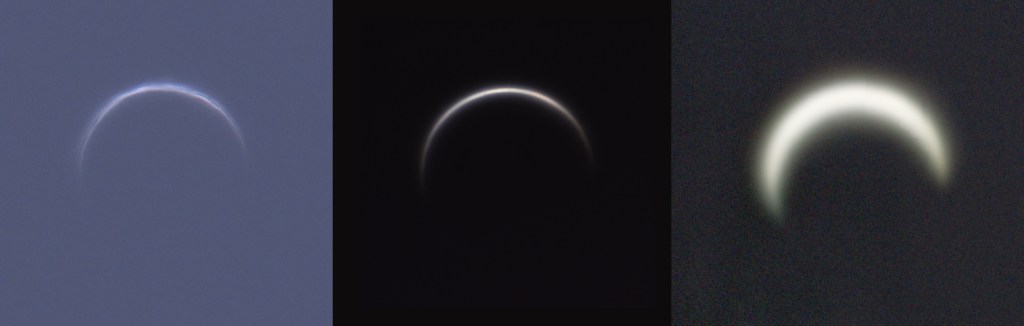
In 2020, Venus went in close solar inferior conjunction, 8 years after its 2012 Solar Transit. It was the first occasion since then the catch the rare “annular phase of Venus”, which requires elongations smaller than 4° to see the ring. See my detailed page on the 2020 Inferior Conjunction of Venus for more details on these observations and the modified telescope I build to observe Venus very near the sun.


In 2023, Venus went again in solar conjunction, but at a much larger solar elongation of 8°. With such elongation, the crescent is barely longer than the “normal” 180°. I had not planned to observe this conjunction, but claimed observations of the Venus ring by Didier Favre prompted my to check myself. With the reasonnable elongation of 8°, to maximize the chance, I used my 190mm diameter Maksutov Newton telescope. As I expected, the ring was not observable and the crescent was barely longer than 180°. Even other observers who made much better captures than mine and Favre’s like these from Wah-Wah did not capture Venus ring. Needless to say that, either the thickness of the atmosphere of Venus had changed just at the time Favre’s image, or …
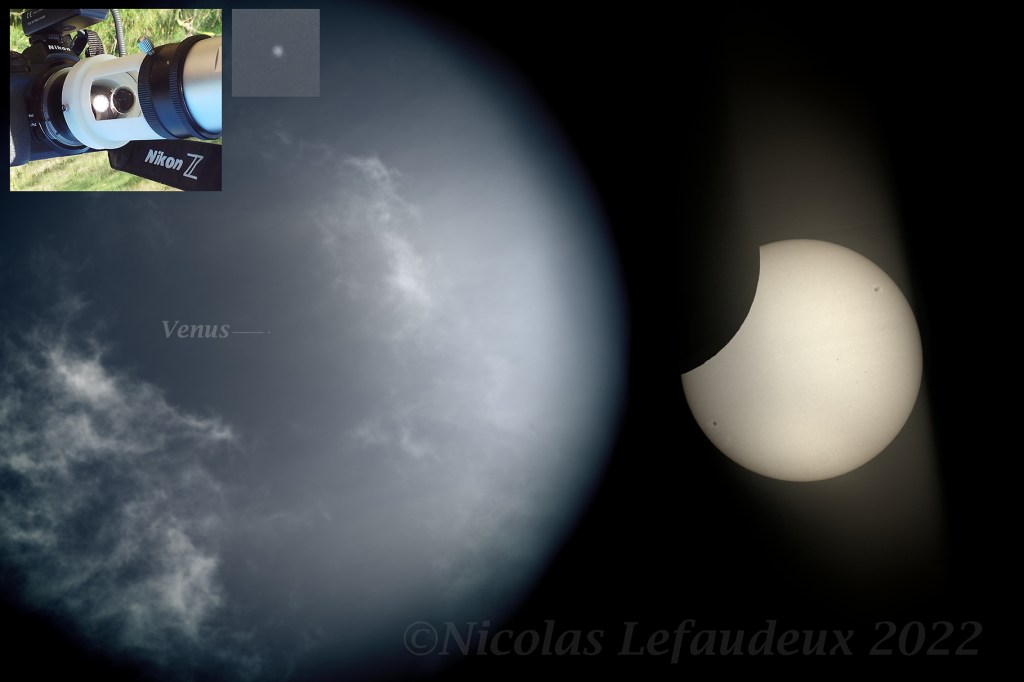
Partial solar eclipse of October 2022 and Venus at superior conjunction
During the Solar Eclipse, planet Venus was nearby, hidden in the sun glare. To capture both the eclipse and Venus, I used a special filter located near the camera, with reflective coating removed on a circular area to be able to have an unfiltered view of venus while getting the required filtration for the eclipse. A 3D printed part allowed to get the reflected beam of sunlight outside of the telescope. The high clouds dramatically decreased the contrast of the planet and made the image quite tricky to get. I had to wait for some clearer break in the clouds to be able to spot Venus in the zoomed image of the camera.

Daylight comets
Comet 96P/Machholz: spotting comets near the sun is a bit different from the case of Venus conjunction. Usually, the comets will not be as close to the sun as Venus, and require a significantly larger field of view. Thus, I fitted my refractor in the reversed tube of a Newton reflector. In this configuration, the secondary mirror directs the image of the comet to the camera, and while the focused sun beam exits the tube. With this setup, I have been able to capture comet 96P/Machholz at 4° elongation from the sun, and around magnitude 1. I will try to use this setup again to image comet Tsuchinshan-ATLAS near the sun on October 9th 2024.

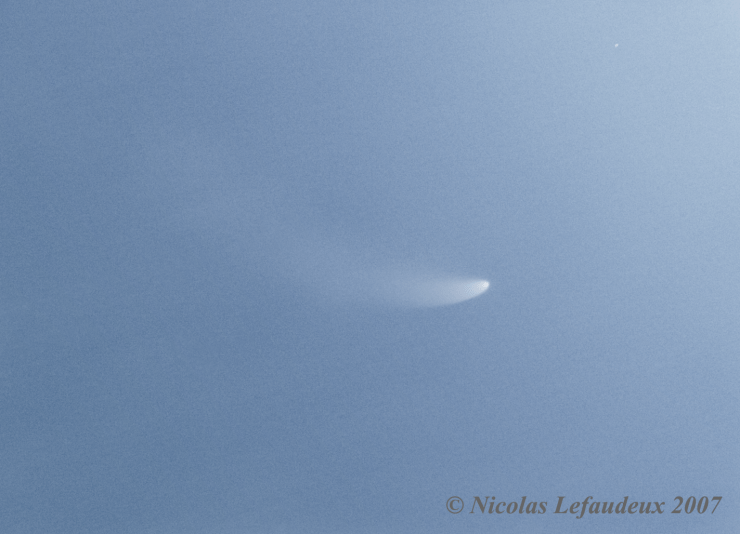
Comet McNaught 2007: Comet McNaught was easily visible in daylight in January 2007 with the unaided eye. Capturing it was rather easy then as one just to hide the sun with any building and photograph it.

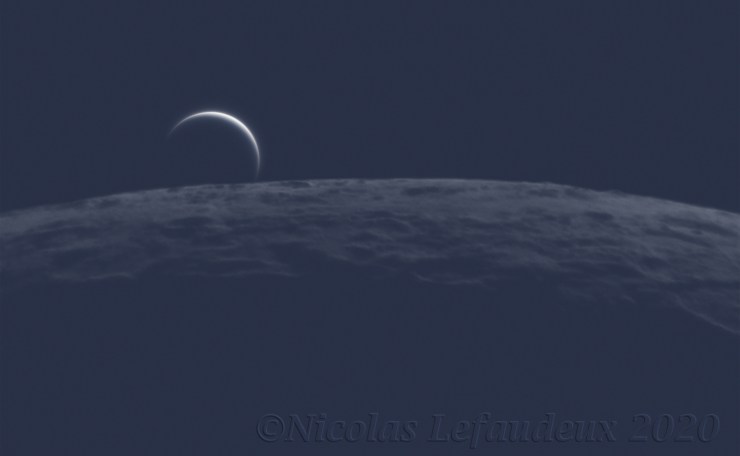
Daylight occultation of Venus
Captured with a 11″ diameter Schmidt-Cassegrain reflector.
Daylight Conjunction of Venus and Jupiter

Transit of Mercury
Captured with a 190mm diameter Maksutov-Newton reflector.

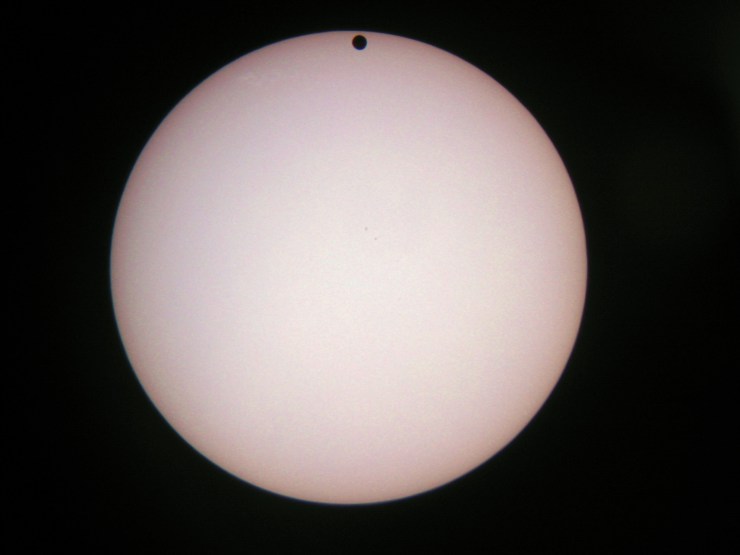
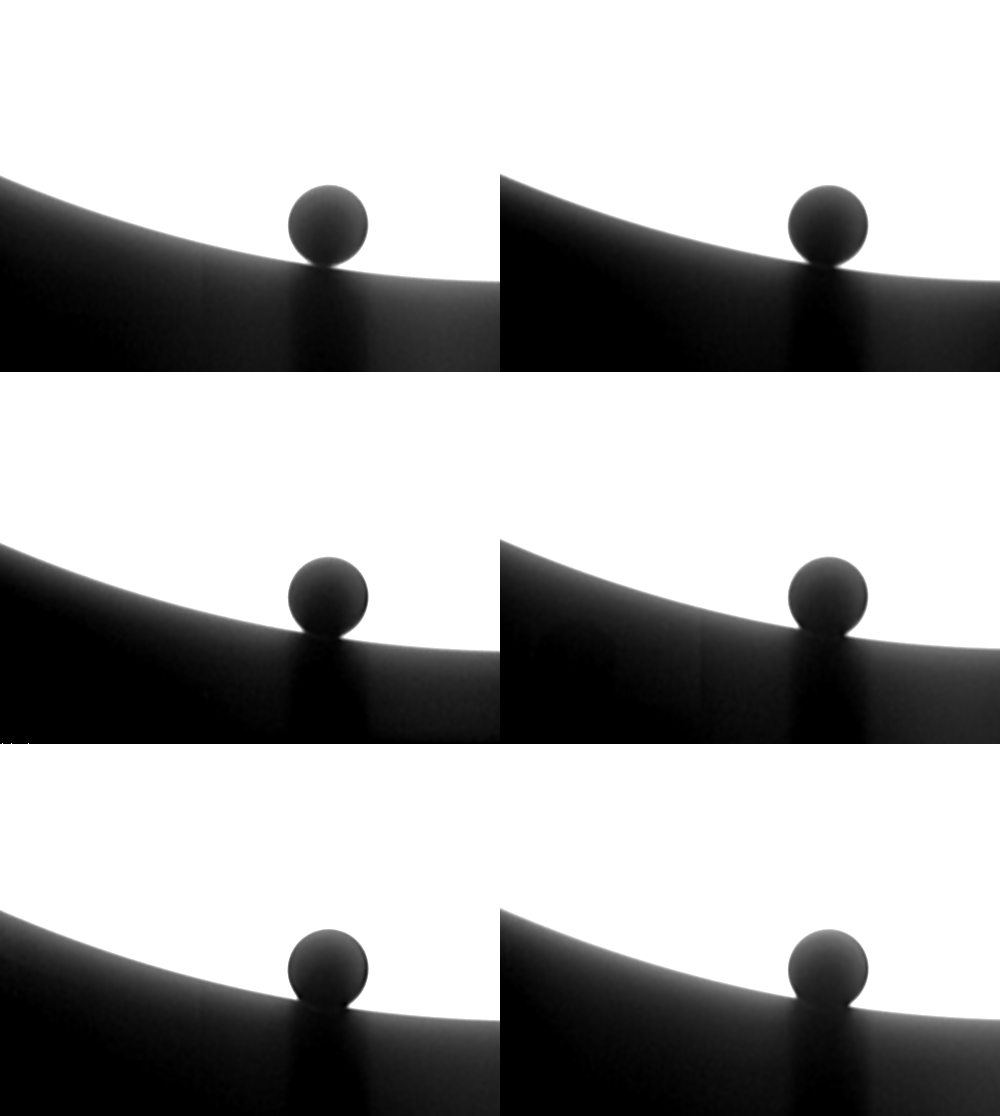
June 2004 Transit of Venus
Captured with a 260mm diameter Dobsonian reflector.

 HDR astrophotography by Nicolas Lefaudeux